文字难度:★★★★
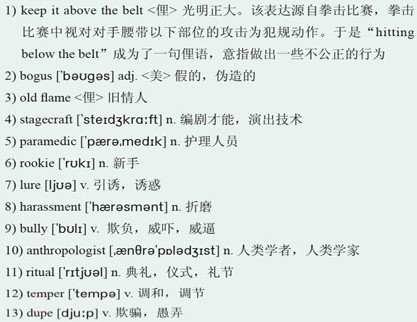
1)Keep it above the belt, stop short of total humiliation and, if possible, mix in some irony, some drama, maybe even a 2)bogus call from the person’s 3)old flame or new boss. A good prank, of course, involves good 4)stagecraft. But it also requires emotional intuition.
要玩就玩得光明正大,别搞那些羞辱人之类的把戏,如果可能的话,就适当加入一点儿讽刺,一点儿戏剧,或许甚至可以是假装旧情人或新上司打来的电话。高明的恶作剧,当然需要好的表演能力。此外,还需要对他人的感受有种直觉上的把握。
“You want to play on people’s weaknesses or dislikes, but not go too hard,” said Tommy Doran, a fireman and 5)paramedic in Skokie, Ill., who as a 6)rookie in Montgomery County, Md., was 7)lured into the station’s kitchen and blasted with multiple cream pies. “For me it’s just the sort of dark humor we use to cope with the job and each other. Nothing dangerous or illegal.”
“要针对别人的缺点或者厌恶好好地恶搞一番没问题,但是切记别太过分,”汤米·德兰说道。他是美国伊利诺斯州斯科基市消防站的一名消防员兼急救员,曾经就试过被人骗进消防站的厨房,然后遭到奶油派轮番“袭击”。“对我来说,那只是我们用以应对工作和彼此相处的一份黑色幽默,既不危险也不犯法。”
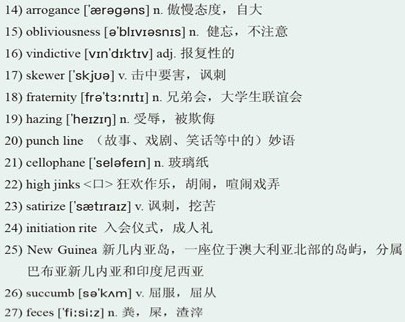
 Psychologists have studied pranks for years, often in the context of 8)harassment, 9)bullying and all manner of malicious exclusion and prejudice. Yet practical jokes are far more commonly an effort to bring a person into a group,10)anthropologists have found—an integral part of 11)rituals around the world intended to 12)temper success with humility. And recent research suggests that the experience of being 13)duped can stir self-reflection in a way few other experiences can, functioning as a check on 14)arrogance or 15)obliviousness.
心理学家们致力于恶作剧的研究已经多年了,研究方向通常都集中在骚扰、欺凌弱小以及各种各样的排外和歧视行为上。但人类学家却发现,整人游戏往往更多是为了让个体融入集体——全球通用的以羞辱打压成功气焰的必经一役。最近的研究表明,被人愚弄的经历能激发一个人去自我反省,检视自己的自负和糊涂,而几乎没有其他哪种经历能有这样的效果。
The 1960s activist and prankster Abbie Hoffman reportedly divided practical jokes into three categories. The bad ones involve 16)vindictive 17)skewering, or the sort of head-shaving, shivering-in-boxers 18)fraternity 19)hazing that the sociologist Erving Goffman described as “degradation ceremonies.” Neutral tricks are more akin to physical 20)punch lines, like wrapping the toilet bowl in 21)cellophane, depositing a massive pumpkin on top of the student union building, or pulling some electronic 22)high jinks on a co-worker’s keyboard (though on deadline this falls quickly into the “bad” category).
据报道,在20世纪60年代,社会活动人士及恶作剧玩家阿比·霍夫曼将玩弄把戏分为了三大类。“坏”的恶作剧通常包括恶意的伤害,如在大学的兄弟会中捉弄新生,剃光人家的头发,让人只穿着短裤冷得发抖,这些被社会学家欧文·霍夫曼称之为“堕落的典礼”。“中性”的恶作剧更像是将笑点活现眼前,比如说给抽水马桶的厕兜包上玻璃纸,在学生会大楼的屋顶上放一个巨型南瓜,再或者是在同事的键盘上做点手脚(但若是碰巧发生在工作中的重要截止日期,那这原本“中性”的恶作剧就会立刻变成“坏”的恶作剧)。
What Hoffman called the good prank, which humorously 23)satirizes human fears or failings, is found in a wide variety of 24)initiation rites and coming-of-age rituals. The Daribi of 25)New Guinea, for example, have children make a small box and bury it in the ground, telling them that after a while a treasure will appear inside but they must not peek, according to Edie Turner, a professor of anthropology at the University of Virginia. Invariably the youngsters 26)succumb to curiosity—only to find a sample of human 27)feces.
那些被霍夫曼称之为“好”的恶作剧,则是以一种幽默的方式去讽刺人们的恐惧和失误,这样的恶作剧往往发生在各式各样的入会仪式和成人礼上。来自(美国)弗吉尼亚州立大学的人类学教授艾迪·特纳给我们举了这样一个例子:新几内亚岛的达日比人会让孩子们做一个小盒子,并把它埋到地下,告诉他们过一会盒子里就会出现宝藏,但前提是他们一定不能偷看。小孩子哪里抵抗得住好奇诱惑,无不例外都会偷看,结果发现盒子里只有人的大便。
The Ndembu of Zambia have an adult in a monstrous mask sneak and scare the wits out of boys camping outside the village as part of a coming-of-age ritual in which they are showing their bravery. “These kind of tricks are very common,” Dr. Turner said, “and they are really a way to put a person down before raising them up. You’re being reminded of your failings even as you’re being honored.”
(非洲)赞比亚的恩登布人会派一个大人戴着可怕的面具,偷偷潜入去吓唬那些在村庄外露营的男孩们,以此作为男孩们成人礼的一部分,测试他们的勇气。“类似这样的恶作剧很常见,”特纳博士说,“而且这确实是在把一个人捧上天之前,让他狠狠摔了一跤。就算他受人敬仰地位很高,也会因此想起自己犯过的愚蠢错误。”
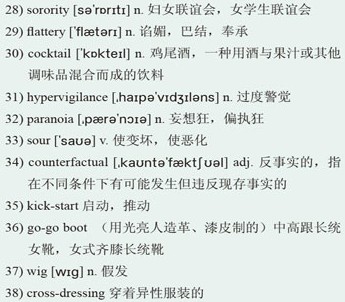
Jonathan Wynn, a cultural sociologist at Smith College, said pranks served to maintain social boundaries in groups as various as police departments and 28)sororities. “And you gain status by being picked on in some ways,” he said. “It can be a kind of 29)flattery, if you’re being brought in.”
乔纳森·韦恩是(美国)史密斯学院的一位文化社会学家,他称恶作剧的作用还包括维持从警察局至妇女组织等各色社会团体之间的界限。“你要是被人以某些方式找岔捉弄,地位会因而提升。”他说,“能被带进那个圈子,是一种给你面子的表现。”
In a paper published last year, three psychologists argued that the sensation of being duped—anger, self-blame, bitterness—was such a singular 30)cocktail that it forced an uncomfortable kind of self-awareness. How much of a dupe am I? Where are my blind spots?
在一篇去年发表的论文中,三位心理学家认为:被愚弄后的感觉混杂着愤怒、自责和怨恨,这种特殊复杂的情绪会迫使人形成一种不安的自我意识。我怎么这么笨呢?我的盲点在哪里?
“As humans, we develop this notion of fairness as a part of our self-concept, and of course it’s extremely important in exchange relationships,” said Kathleen D. Vohs, a consumer psychologist at the Carlson School of Management at the University of Minnesota. Dr. Vohs and her co-authors, Roy F. Baumeister of Florida State University and Jason Chin of the University of British Columbia, propose that the fear of being had is a trait that varies from near-obliviousness in some people to 31)hypervigilance in others.
“我们人类,已经把‘公平’这一观念发展成为我们‘自我概念’中的一部分。而且毋庸置疑的是,‘公平’在交换关系中极为重要。” 凯瑟琳·D·佛贺斯说道,她是一名来自(美国)明尼苏达州立大学卡尔森管理学院的消费者心理学家。佛贺斯博士与她的合著者——(美国)佛罗里达州立大学的罗伊·F.·鲍迈斯特,以及不列颠哥伦比亚大学的贾森·陈,一起提出这样的观点:人们对于恶作剧引起的恐惧心理因人而异,有些人会觉得无关痛痒,而有些人则会过度警觉。
The researchers had 55 men and women play a computerized cooperation game and demonstrated that participants who felt they had been burned would go over the experience in their heads, playing out alternative versions of how they might have behaved. “Being duped holds up this mirror to people,” Dr. Vohs said, “and may in fact show them where they are on the scale”—too trusting or too vigilant. 32)Paranoia, too, has its costs, and it can 33)sour relationships.
研究者做了这样一个实验:让55名男女尝试一个电脑辅助的游戏。实验结果表明,那些感觉自己曾受创伤的参与者会在脑海里重温经历,作出不同以往的反应。“被愚弄过的人们时刻握着这面镜子对照自己,”佛贺斯博士这样说,“这实际上也可能给他们提供了一个警觉度的参考。”——是过度信任呢,还是过度警惕。疑心偏执也是有其代价的,还可能使人际关系恶化。
Running back the tape mentally, in this case meditating on how an embarrassing event might have turned out otherwise, is known to psychologists as 34)counterfactual thinking. “The feeling of ‘I should have known better’ is the sort of counterfactual that serves to highlight your own shortcomings,” said Neal Roese, a psychologist at the University of Illinois. “A good deal of research has shown that these counterfactual insights can 35)kick-start new behaviors, new self-exploration and, ultimately, self-improvement.”
在脑海里慢慢回放事件的记忆,并同时对这桩出糗事件的其他可能性结果进行假设思考,这就是心理学家们称之为“反事实思维”的一种思维活动。“那种‘我应该早就察觉到了’的感觉就是一种反事实的思考,它会突显出你的缺点。”(美国)伊利诺伊大学的心理学家尼尔·罗塞如是说,“大量研究已表明,这些反事实的自我思考会激发人们做出新的行为表现,新的自我探索,并最终使人自我改善。”
Those observations may not leap to mind if you just showed up in 36)go-go boots and an Elizabeth Taylor 37)wig to a bogus 1970s 38)cross-dressing party. Or if you fell for the e-mail message announcing you had won an award and should forward a draft of your acceptance speech to a supervisor.
然而,如果你只是脚蹬高筒长靴,头戴伊丽莎白·泰勒式假发,跑去参加一个假的20世纪70年代风格的异装派对;又或是轻信了一封通知你获奖并让你给上级交一篇获奖感言草稿的邮件,那你可能不会获得上述那种认知。
But a good prank is, in the end, a simulation of a crisis and not the real thing. And it serves as a valuable reminder that not every precious box contains precisely the treasure you might expect.
不管怎样,一个成功的恶作剧,最终也不过是一场危机的模拟演示而已,并不是真的。而且它还是一种宝贵的提醒:并非所有美丽精致的盒子里就一定装着那些我们所期待的珍贵宝藏。