文字难度:★★★
The word “taboo” (also spelled “tabu”) is Polynesian and means “sacred” or “forbidden”; it has a 1)quasi-magical or religious 2)overtone. The term was introduced to 3)anthropological literature in the second half of the nineteenth century. When you dig out what is hidden behind the forbidden, we can see people deal with “taboo” for many reasons, from culture to religion.
Taboo(禁忌)”(亦拼作“tabu”),这个词来源于波利尼西亚语,它的意思是“神圣的”、“被禁止的”,有类似于魔力方面的意味或带有宗教方面的暗示。它最早出现在19世纪下半叶的人类学文献中。当挖掘“被禁止”背后隐藏的秘密时,我们能发现,从文化到宗教,人们涉及“禁忌”的原因有很多。
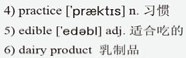
 In the field of food and nutrition, food taboos are not necessarily connected with magical-religious 4)practices, and some nutritionists prefer to speak of “food avoidance.” Food is a culturally specific concept. In general, anything can function as food if it is not immediately toxic. But what is 5)edible in one culture may not be in another. The concept of food is determined by three factors: biology, geography, and culture.
在饮食营养方面,食物的忌讳不一定与神力或宗教习俗有关,一些营养学家更倾向于称之为“避食习惯”。何为食物,这是因文化而异的概念。一般而言,本身没有毒性的东西都可为食物。然而,一种文化视为可食之物,到了另一种文化中就不一定如此。能否成为食物跟三个因素有关:生物特性、地理环境和文化习惯。
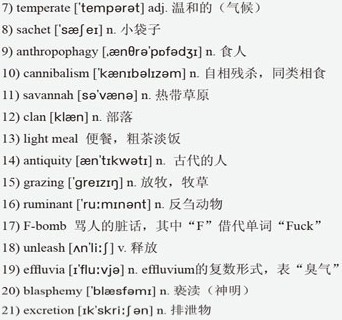
Certain plants and animals are not consumed because they are indigestible. Geography also plays a role. For example, 6)dairy products are not part of the food culture of the humid tropical regions since the geographical conditions for keeping cattle are unfavorable. Milk is often a taboo food in such cultures. Insects are not considered food in Europe and most of the United States despite attempts to introduce them in the late twentieth century. This is because there are few edible insects in regions with 7)temperate climates. In Mexico, by contrast, insects are packaged in plastic 8)sachets, cans, or jars for sale.
人们不食用某些食物,是因为它们不易消化。同时,地理环境也起着作用。例如,在潮湿的热带地区,乳制品不出现在其食物文化中,是因为那里的自然环境不适宜畜养牛羊,因此,在这些地区,奶类也就时常成为一种食物禁忌。在欧洲和美国的大部分地方,昆虫无法成为当地人的食物,尽管二十世纪末人们多次尝试向那里引入昆虫美食。究其原因,是因为在温带地区,人们几乎找不到可以食用的昆虫。相反地,在墨西哥,昆虫是成袋成罐地卖给人吃的。
Meanwhile we also have permanent food taboos. For example, in Western society cats and dogs are not consumed because of the emotional relationships developed with these pets. Increasingly pets are being “humanized” in such a way that eating them is seen as an act of 9)anthropophagy or 10)cannibalism. The feeling of closeness to certain animals can also be found in the 11)savannah regions of West Africa. Certain West African 12)clans consider dogs clan animals, based on the fact that they have been beneficial to the clan in the past; as clan animals they are unfit for consumption. Hippocrates regarded dog meat favorably as a 13)light meal, but in later 14)antiquity, dogs were considered unclean and unfit to eat. This is still the case in the Mediterranean area and the Middle East. By contrast, dog meat is popular in China and the mountainous regions of the Philippines. Actually, from a nutritional point of view, dog meat is an excellent source of animal protein, and dogs do not require the 15)grazing area demanded by cattle or other large 16)ruminants.
同时,有些食物的禁忌是长久存在的。举个例子,在西方社会里,猫和狗是人们的宠物,并与人们有着亲密的情感关系,所以这些地方的人们是不会食用猫和狗的。随着这些宠物日益被“人性化”,人们认为食用这些动物的行为有如食用自己同类一样残忍不已。这种与某种动物之间有着亲密情感关系的情况在西非的热带草原地区也存在。在西非的一些部落中,因为在过去狗对于他们的部落生存发展有利,所以人们把狗当成一种部落守护动物,如此一来,狗便成了被禁止食用的动物。希波克拉底(古希腊医师,人称医药之父)则认为狗肉是很好的便餐,但是后来,古人却认为狗不干净,所以不能吃。直到今天,在地中海和中东地区,情况依然如是。与此相反的是,在中国和菲律宾的山区,狗肉却很受青睐。而事实上,从营养学的角度来看,狗肉的确是动物蛋白的理想来源,而且狗不像牛或其它大型反刍动物那样需要宽阔的牧场来放养。
As there are so many taboos for what we swallow down, how about what we spit out? The 17)F-bomb was respected and seldom used. But today, Americans are dropping F-bombs (also known as “using the F word”) with reckless abandon. Men, women, and children alike 18)unleash the power of the F-bomb at will. Certain concepts or phrases are taboo on an international level. In general, references to death, bodily 19)effluvia, or sex are considered taboo, as well as 20)blasphemy.
讲了这么多“吞下去”的禁忌,那“吐出来”的禁忌又是怎样的呢?在过去,对英文的“四字骂词”,大家都敬而远之,鲜少使用。但是如今的美国人却无所忌讳,无论是男是女,老老少少,都随口而出,将其作为一种宣泄的方式。然而,有些词语的禁忌是具有全球性的。一般来说,与死亡、人体臭气、性爱和亵渎神明这些含义有关的话语都是禁忌。
Man-Ping Chu states that “Two verbal taboos are probably universal. The first of these are words that deal with 21)excretion and sex. […] Second, in both Western and Asian cultures the fear of death carries over into fear of the words having to do with death.”
朱蔓萍(美国德州农工大学双语教育研究所博士)认为,“有两种语言忌讳是全球普遍存在的。第一种是那些与人体排泄物和性有关的词语……;第二种是与死有关的词语,无论是在西方还是东方的文化中,人们对死亡的恐惧造成了对与死相关的词语的恐惧。”
Certain words are also considered taboo merely because they sound like a taboo word. For example, to many Chinese, giving a fan as a gift is a taboo because the Chinese word for “fan” sounds very like the word for “separation,” which is associated with death. In American society, we avoid “circumscribe, excavate (associated with “evacuate”), excrescence (associated with “excrement”), masticate, menstruation, privet, rapier, rumpus, sects, titter, vile (associated with “bile”). Even the word “vowel”, which could refer to the word “bowel”. “Roaches” started to oust American “cockroaches” in the eighteen twenties; “haystacks” began to replace “haycocks”.
而有些词之所以成为忌讳,是与它们的发音有关。例如,对于许多中国人来说,把扇子作为礼物是一种忌讳,那是因为“扇”与“散”的发音相近,而“散”有死亡方面的不好含义。在美国,由于发音的关系,人们避免使用以下这些词:“circumscribe(“限定”,与意为“阴蒂”的“circumcise”发音相近),excavate(“挖掘”,与意为“排泄”的“evacuate”发音相近),excrescence (“瘤”,与意为“排泄物”的“excrement”发音相近),masticate(“咀嚼”,与意为“手淫”的“masturbate”发音相近), menstruation(“月经”,这本身就为禁忌的话题),privet(“女贞”,与意为“厕所”的“privy”发音相近),rapier(“剑”,与意为“强奸”的“rape”发音相近),rumpus(“喧闹”,与意为“大便”的“rump”发音相近),sects(“教派”,与意为“性”的“sex”发音相近),titter(“窃笑”,与意为“乳头”的“tit”发音相近),vile (“可耻的”,与意为“胆汁”的“bile”发音相近)。甚至还避免使用“vowel”这个词,就因为它与“bowel(肠)”的发音相近。除此之外,在1820年,美国人开始用“roaches”代替“cockroaches(蟑螂)”,而“haystacks”也开始代替“haycocks”(编者注:“haycock”中“cock”在俚语中用来表示“男性生殖器”,所以避讳使用),都是与它们的发音有关。
So as a response to all of these topics, polite society developed the “22)euphemism.”Euphemistic phrasing can be used to politely refer to any taboo topic. We have “restroom” to describe the room where no one really rests, and “passed away”, “departed”, or “was gathered to his fathers” to substitute for “died”. People who engage in sexual activity are “sleeping together,” though they are certainly doing more than just sleeping. But nowadays, our society has become progressively more tolerant toward a taboo as people continually violate it. What a person decides about what one is permitted to say is still a personal decision, but hopefully we have 23)shed some light on the subject and given you a chance to think about your words before you open your mouth.
为了避免使用这些忌讳的词语,上流社会的人开始使用“委婉语”。想要文明有礼地谈及某些禁忌话题时,委婉语便能派上用场。因此我们有了“restroom”(“洗手间”)一说,尽管那里并不是真正让人休息的房间,还有“passed away”,“departed”和“was gathered to his fathers”这样的表达,用来代替“died”(“死”)。对于人们发生的性行为则用“sleeping together”来表达,虽然人们做的不仅仅是睡觉而已。但是今时今日,人们已对禁忌抱有更为宽容的态度了。所以至于什么能够说,什么不能够说,则见人见智。话虽如此,还是希望上文能给你一些启发,让你在开口前三思一下。