科技强,科技棒,人脑却呈退化状? Tech Is Good, Tech Is Great, But Will Your Brain 1)Deteriorate?
文字难度:★★★
I don’t want to 2)poop on anyone’s parade. I’m not an3)anti-Techrist or 4)diginazi—but I do have concerns about how much humankind depends on technology. From making friends and finding love to parallel parking, the tech 5)boom we’ve blasted through over the last decade has moved much faster than we’ve had time to get used to. This has undoubtedly affected our brains.  我不是要泼谁的冷水。我既非反科技人士,亦非电子独裁者,只是担心人类过分依赖科技的这种现状。从交友到觅偶,再到平行泊车,在过去十年里,我们所鼓吹的科技发展热潮让人应接不暇。毋庸置疑,我们的大脑已然受到影响。
Yes, technology has brought about many improvements to society and even shown us that the brain can continue to grow and learn as we get older. But here are some of the most widely used technologies and the possible damages they can do to your biological supercomputer.
诚然,科技带来了社会进步,且证明了即使随着年龄的增长,我们的大脑仍可持续生长发育和学习。但是,以下最为广泛使用的科技却可能使大脑这个“超级生物电脑”遭到损害。
The Disappearance of Real 6)Social Butterflies
真正的交际能手不复存在
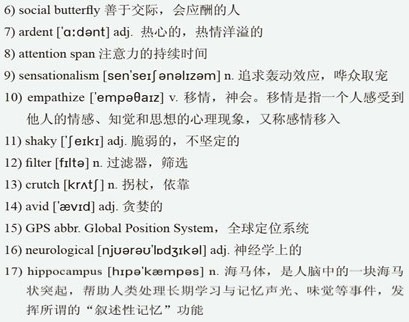
Have you ever noticed the most 7)ardent social networkers aren’t quite social butterflies when it comes to off-screen interactions? Coincidence it is not. Oxford University neuroscientist Susan Greenfield, a prominent researcher in the field of social networking and the physiology of the brain, claims that “social networking could lead to short 8)attention spans, 9)sensationalism, inability to 10)empathize, and a 11)shaky sense of identity.”
不知您可曾留意到那些热情神侃的社交网友在现实中并非真正的交际能手?而这绝非偶然。牛津大学神经学家苏珊·格林菲尔德是研究社交网络及大脑生理学的著名专家,她提出说“社交网络能导致人的注意力持续时间缩短、喜欢哗众取宠、移情能力丧失,以及缺乏归属感。”
Especially in the case of adolescents, she worries that social network sites like Facebook and Twitter present an alternative to real exchanges and this can be harmful to an adolescent’s social development. It’s already difficult enough for most adolescents to comfortably interact with one another, but Greenfield worries they’ll use the 12)filter of online chats as a 13)crutch and never develop proper social and communication skills.
这些情况在青少年身上表现得尤为明显。她担心像脸谱网、推特这类的社交网站会替代了现实生活中的交流,而这将不利于青少年的社交能力发展。对于绝大多数青少年而言,与人轻松互动已非易事;但格林菲尔德担忧的则是他们过度依赖网络聊天,导致无法培养出恰当的社交与沟通技能。
14)Avid 15)GPS Use Can Wipe Out Your Memory Banks
过分使用GPS令记忆库干枯
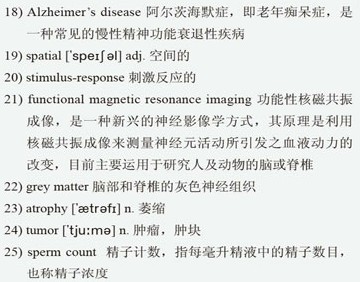
16)Neurological researcher Veronique Bohbot and her colleagues at Montreal’s McGill University released three studies on the effect GPS has on the human brain. Their results suggest that avid GPS use may reduce 17)hippocampus function as we age. The hippocampus is the part of the brain involved in memory and navigation processes and is also one of the first areas of the brain to be affected by 18)Alzheimer’s disease.
神经学研究员维诺妮卡·鲍伯特及其在蒙特利尔麦吉尔大学的同伴共同发表了三项关于GPS对人脑影响的研究结果。结果显示,随着年龄的增长,过分使用GPS可能导致海马体的功能减弱。海马体在人脑中起到记忆和导航功能,也是阿尔茨海默症(老年痴呆症)最先影响的部位。
There are two major ways of navigating: 19)spatial navigation (using visual landmarks to tell us where we are) or by 20)stimulus-response methods (turning at certain places because of repetition, as though on auto-pilot). The latter is most familiar to those using GPS.
导航有两种方式:空间导航法(靠视觉地标定位)和刺激反应法(靠不断重复来确定方向,有如自动导航)。后者与使用GPS导航最为相似。
21)Functional magnetic resonance imaging (fMRI) scans were taken of older adults who were GPS and non-GPS users. Those who used spatial navigation strategies (i.e. the non-GPS method) had increased activity and a greater volume of 22)grey matter in the hippocampus than those who relied on GPS. The study indicated that those who used GPS-like stimulus-response could be at risk for showing 23)atrophy of the hippocampus over time.
研究人员使用功能性核磁共振成像来扫描GPS使用者和非GPS使用者的大脑。使用空间导航法(即非GPS法)的人,他们的大脑活动更为活跃,海马体的灰质也比GPS使用者的多。研究表明,长期使用GPS式刺激反应法进行导航的人将面临海马体萎缩的危险。
Notably, an earlier study conducted by researchers at the University of London showed that London taxi drivers who spent three years learning their way around London by spatial methods rather than GPS had a region of the hippocampus that was significantly larger compared to the general population and even bus drivers.
同样值得注意的是,早前由伦敦大学的研究员进行的一项研究发现,那些花三年时间转遍伦敦,以空间导航法认路的伦敦出租车司机,他们的海马体比一般人的,甚至是公交车司机的还要大。
Cell Phone Radiation May Damage DNA
手机辐射可能损害DNA
The debate about cell phones causing brain cancer and damaging DNA has been an ongoing issue and it’s quite difficult to know where to stand. On the one hand, you have a four-country study which took place in Denmark, Finland, Norway and Sweden, which found no increase in brain 24)tumor diagnoses from 1998 to 2003. But then new research presented by Devra Davis, the founding director of the Toxicology and Environmental Studies board at the U.S. National Academy of Sciences, claims the most popular gadget of our time has been shown to damage DNA, break down the brain’s defenses, and reduce 25)sperm count while increasing memory loss, the risk of Alzheimer’s disease, and cancer. Davis warns that the growing brains of children make them especially vulnerable.
人们对手机能致脑癌和损害DNA的问题热议不断,那些或支持或反对的声音叫人莫衷一是。一方面,在丹麦、芬兰、挪威和瑞典四国进行的一项调查发现1998年到2003年间脑瘤病例并无增长。但美国国家科学院毒物学及环境研究中心的创办人及主管黛芙拉·戴维斯,则在其最新研究中发现:这个当今最流行的小玩意会损害DNA、破坏大脑的防御能力、减少精子计数,同时还会加速记忆丧失、 加大患阿尔茨海默症(老人痴呆症)和癌症的风险。戴维斯还发出警告:儿童正在发育的大脑特别容易受到伤害。
While I’m not sure I am going to completely jump on board with this theory, I do think it’s better to be safe than sorry. Although short-term exposure is almost26)unanimously agreed to be quite harmless, long-term cell phone use tells a different story. Three studies since 1999 indicate that people who have used cell phones for more than a decade may have as much as three times greater risk of developing brain tumors on the side of the head which they most often hold their phone.
虽然我不知道自己是不是该马上认同这种理论,但我想防范于未然还是好的。尽管大家都认同短时间使用手机不会带来什么危害,但长期使用却另当别论了。有三项研究表明:自1999年以来,使用手机并长达十年的人,经常听话筒的那边大脑患脑瘤的几率有三倍之高。
Information Overload and Multitasking
超负荷的信息量与多重任务
I work in computers and was unsurprised to find out that computer users at work change windows, check e-mails or other programs nearly 37 times an hour. A study from the University of California claims that we last, on average three minutes at work before something interrupts us. Again, something I can attest to first-hand.
我是用电脑工作的,所以对电脑使用者以高达每小时37次的频率切换窗口、查电子邮件以及切换程序的行为见怪不怪。加利福尼亚大学的研究告诉我们:平均每三分钟我们的工作就会受到干扰。又一次,我本人也能亲自作证。
Scientists say 27)juggling e-mail, phone calls and other incoming information can change how people think and behave. They say our ability to focus is being 28)undermined by bursts of information. While many people say multitasking makes them more productive, research shows that heavy multitaskers actually have more trouble focusing and shutting out irrelevant information, and experience more stress. Even after the multitasking ends, fractured thinking and lack of focus persist.
科学家说兼顾处理邮件、电话以及其他涌入的信息,会改变人们的思维和行为方式;信息爆炸正损害着我们集中精神的能力。正当许多人都说多重任务能提高工作效率的同时,研究却发现沉重的多重任务其实会使人难以集中精神及排除无关信息,压力增大。即使在任务完成后,思维断续、无法集中精神的状况也会持续。